AI-Driven Integrated and Automated Materials Design for Extreme Environments (AMDEE)

About AMDEE

The AMDEE project is building the future of materials discovery through the seamless integration of AI, high-throughput experimentation, robotic automation, and physics-based modeling. Our goal is to transform how advanced structural materials are designed for extreme environments, such as those encountered in protection systems and hypersonics.

The AIMD-L Platform

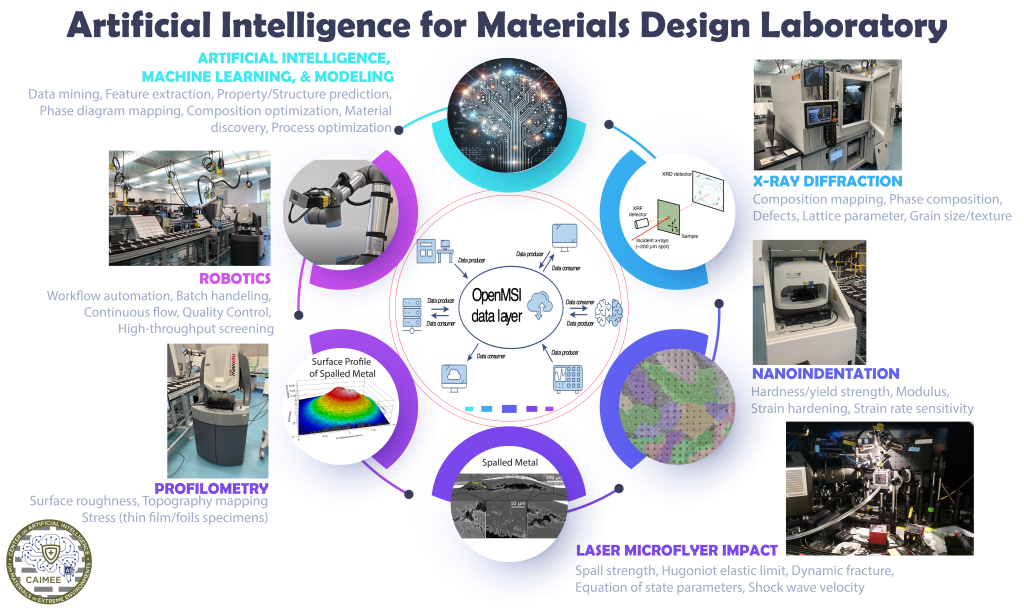
At the core of AMDEE is the AI for Materials Design Laboratory (AIMD-L), a modular, state-of-the-art facility that enables:

    • High-throughput sample fabrication (e.g., sputtered foils, DED samples, combinatorial processing)
    • Rapid microstructural and mechanical characterization using advanced x-ray diffraction (XRD/XRF), deep-UV microscopy, and nanoindentation
    • Automated dynamic testing via laser micro-flyer impact (HELIX system) reaching strain rates of 10⁶–10⁸ s⁻¹
    • Closed-loop robotic automation for autonomous handling, testing, and processing across all stations
    • An event-driven data infrastructure for real-time integration, decision-making, and experiment optimization
Scientific Vision

AMDEE tackles key bottlenecks in materials design:

    • Limited throughput for testing under extreme conditions
    • High cost and manual burden in experimental workflows
    • Reliance on expert intuition rather than scalable, systematic exploration

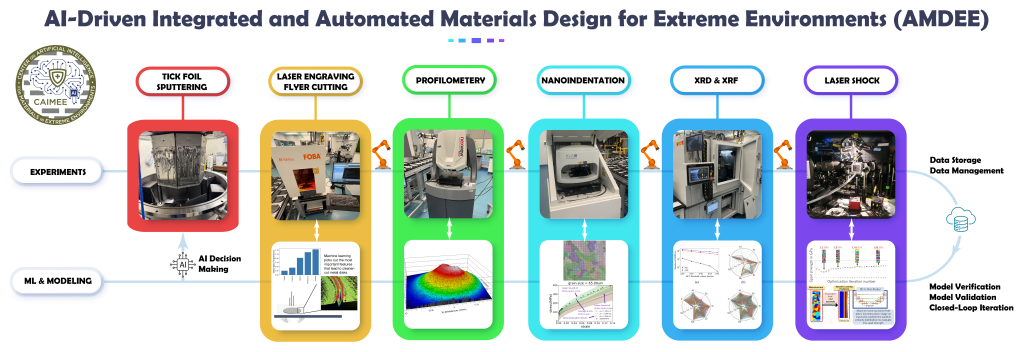
Our solution is a multi-fidelity, AI-guided design loop, where:

    • Physics-based models and experimental results inform surrogate models and machine learning predictions
    • Bayesian optimization and ensemble-variational methods guide discovery across vast composition and microstructure spaces
    • Robotic automation enables real-time, autonomous decision execution
    • AI tools to predict mechanical properties from microstructure with quantified uncertainty

What Makes AMDEE Unique?

    • Closed-loop integration: Sample design, fabrication, testing, and analysis are linked in real time using an event-driven data architecture.
    • Scalable experimentation: High-throughput nanoindentation, automated XRD/XRF, deep-UV Fourier ptychographic microscopy, and autonomous laser shock tests support rapid materials screening.
    • Multimodal data fusion: AI and physics models work in tandem to understand processing–structure–property–performance (PSPP) relationships.
    • Focus on extreme environments: Our materials are designed for high strain rate and high temperature—conditions relevant to next-gen applications.

Recent Milestones

    • Fully automated “see-move-shoot” HELIX experiments at high strain rates and high temperatures
    • Deep-UV ptychographic microscope with autonomous data processing
    • Real-time streaming and decision-making infrastructure (via OpenMSI and Apache Kafka)
    • First-generation AI models for microstructure-to-stress-strain curve predictions with uncertainity quantification of alloys
    • First-generation AI models for microstructure-to-spall strength prediction for pure metals
    • PAL-SEARCH Bayesian optimizer identifying optimal alloy systems faster than expert heuristics

Current Focus Areas

    • Lightweight Al-Mg systems as a model platform for AI-guided alloy optimization
    • Cu-Ti model systems to validate AI predictions with controlled microstructures
    • Refractory multi-principal element alloys (RMPEAs) with exceptional high-temperature spall resistance
    • Ceramics and composites via collaboration with ARL for next-gen armor applications

Data Infrastructure

Our event-driven data layer enables:

    • Live data streaming from robotic stations
    • Automated data reduction, feature extraction, and decision delivery
    • Cross-platform interoperability and FAIR data practices

This infrastructure powers autonomous learning loops, allowing AI to adaptively choose experiments and guide robotic workflows.

Core Team

Jaafar El-Awady

Associate Director, CAIMEE Director, AMDEE

Lori Graham-Brady

Director, CAIMEE

Todd Hufnagel

Director, AIMD Laboratory

Acknowledgement Statement

Research was sponsored by the Army Research Laboratory and was accomplished under Cooperative Agreement Number W911NF-23-2-0062. The views and conclusions contained in this document are those of the authors and should not be interpreted as representing the official policies, either expressed or implied, of the Army Research Laboratory or the U.S. Government. The U.S. Government is authorized to reproduce and distribute reprints for Government purposes notwithstanding any copyright notation herein.