
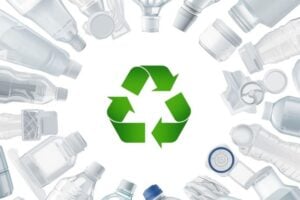
Despite plastic’s ubiquity, only about 9% of it is recycled globally. That number is even lower in the U.S., at around 5%. That makes it crucial to preserve and reuse as much of this non-biodegradable material as possible.
Recycling seems simple: throw your refuse into a bin and it disappears. But what happens next, and how much is reused? A team of engineers looked at the most commonly-used plastics to determine rates of cross-contamination, how much material is salvageable, and how to maximize recovery.
The team, led by Vicky Nguyen, professor of mechanical engineering and co-deputy director of the Hopkins Extreme Materials Institute, looked at the two most common types of plastics, polyethylene (PE) and polypropylene (PP), collectively known as polyolefins. They developed a method to estimate contamination levels in raw materials before and during processing and measured how contamination affects plastics’ failure and material properties. Their findings were published in Polymer Engineering and Science.
PE is used for piping, food packaging, and plastic bags. PP—referred to as “the steel of plastics”—is used in a wide variety of products from automotive parts and medical devices to take-out food containers. Though related, the two are not interchangeable.

“In a recycling center, the first step is that a bunch of people pick out things made from PE, like milk jugs, and separate them,” Nguyen says. “The problem is that PE is also used to make cling wrap and other film packaging, and those get mixed in with the PP take-out containers. Once it’s all ground up together, it is impossible to fully separate the two.”
The different plastics are difficult to process because they do not mix well in the melt, resulting in unstable processing and poor mechanical properties in the finished material. Polymer processing engineers can compensate by adjusting the processing parameters if they know the contamination level. But contamination varies widely batch to batch.
Using thermal measurements, X-ray scattering, electron microscopy, and tensile testing, the team found contamination levels ranging from 0% to 40%. The good news: impurities below 20% are essentially indistinguishable from unrecycled PP. The bad news: contamination is not always detected, and many recycled PP batches have unknown levels of contamination.
For samples processed with a layer-multiplying element (LME), which increases the number of layers in a film without changing its thickness, the team found and increase in overall strength, performance, and reliability of recycled PP in the direction of the perpendicular layers. Nguyen says that finding could help enhance the consistency of recycled polyolefin films at scale.
“Strength, ductility, and overall quality can drop up to 70% due to contamination,” Nguyen says. “LMEs can improve this number by as much as 100% by improving overall uniformity.”
