
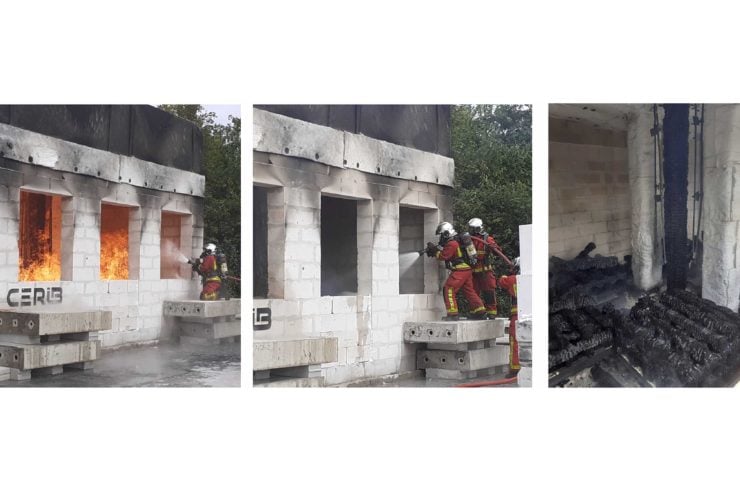
In an effort to improve building fire safety, Associate Professor Thomas Gernay from Johns Hopkins University’s Department of Civil and Systems Engineering has published a new study that examines how load-bearing wooden columns—increasingly used in taller buildings—behave when exposed to heat from fires, including the overlooked cooling phase that follows extinguished flames.
Appearing in Engineering Structures, the study from Gernay and his collaborators evaluates a thermal wave effect on the burnout resistance of timber structures, in other words, how continued temperature rise within the core of timber beams affects their structural resilience after a fire has gone out. The team’s results have the potential to change the way engineers design timber structures to ensure they can withstand the entire course of a fire without risking collapse once the flames have been extinguished.
“Traditionally, engineering design and practice have focused on fire resistance based on standard tests that assess how columns perform under continuous heating until failure, but there’s no consideration for how a structure responds to the heating-cooling sequence that actually occurs in a real fire,” says Gernay.
In one of Gernay’s previous studies, he identified timber structures as being particularly vulnerable to delayed failure after a fire has subsided due to wood’s combination of low thermal conductivity and rapid loss of strength in high temperatures. Wood’s compressive strength is already significantly reduced at 100 degrees Celsius, whereas steel and concrete remain relatively unaffected until 400 C.
Using both a controlled furnace environment and realistic fire scenario tests, the team tracked detailed temperature changes within load-bearing columns and compared those with numerical models that were developed prior to the fire testing phase. The results from the tests and numerical models were much the same, confirming the researchers’ hypothesis that the temperature inside timber columns continues to rise long after visible flames are gone. Most of the timber columns eventually failed, often long after the gas temperatures had begun to decrease.
The team says that this effect, known as delayed collapse, poses substantial risks for building occupants and fire and rescue forces, especially as timber is increasingly used for taller and larger buildings due to several factors like sustainability, the architectural value of wood, and the ability to build stronger structural systems of mass timber.
“Historically, timber was used for relatively small buildings using standard, prescriptive fire resistance specifications which was enough to ensure safe buildings, but our results show that prescriptive fire resistance thinking cannot simply be applied to the new reality of taller, more consequential structures,” says Gernay. “Our tests indicate that delayed structural collapse is a real threat, so we need to give engineers methods to design timber framing that can survive a fire until full burnout.”
With data from 20 full-scale fire tests with varying rates of heating and cooling, the team was also able to investigate several other parameters, including the point at which the columns could resist the thermal wave effect, with the goal of surviving until burnout.
“When looking at the data from the fire tests, we noticed another phenomenon not captured by our models—that larger column sections could fail more than 10 hours after ignition due to smoldering, which is a slow flameless combustion,” Gernay says.
“Imagine a major fire in a 20-story building with hundreds of columns. Would we require firefighters to enter the building and spray each potentially affected column when we know that structural collapse can still occur, even after the fire has cooled?” he asks.
Using 12 loaded columns made of glued-laminated timber and sections measuring between 280x280mm2 and 400x400mm2, each column was tested for resistance under a natural compartment fire, with one test using water to extinguish the fire after 35 minutes. All of the tests ended in structural failure, except for the one which was extinguished by water. The researchers say this analysis highlights how challenging it is to design timber structures that are able to withstand an entire fire event without intervention.
Gernay says that increasing the column size can be a solution against the thermal wave effect, but it would be crucial to also address smoldering, which currently shifts much of the responsibility to fire departments.
Gernay’s research on burnout resistance, along with the published data on timber modeling and experimentation, has garnered significant interest. His work is cited in the background document for the Netherlands Technical Agreement 6125, “Fire safety of mass timber structures,” and has been adopted by engineering design firms like Jensen Hughes. His studies have even attracted attention from firefighters given the risk of delayed structural collapse following fires.
With this experimental study complete, Gernay is now leading a project funded by the National Science Foundation and aims to develop new, fire-resilient designs for timber buildings by combining computational modeling, machine learning, and topology optimization, an approach that determines the most efficient use of material distribution to meet performance goals.
“We need mass timber designs that are burnout resistant, those that go beyond standard fire resistance specifications, so we first have to understand the material’s behavior throughout a complete fire lifecycle and be able to design structures so that a fire in a room doesn’t result in a disproportionate collapse a couple of hours later,” Gernay says.
Study collaborators include Hopkins alumnus Chenzhi Ma, Engr ’25 (PhD); Silvio Renard and Fabienne Robert from the CERIB Fire Testing Centre; Jean-Marc Franssen from Liege University; Jochen Zehfuß from Technische Universität Braunschweig; Research Institutes of Sweden’s Robert McNamee; and Politecnico di Milano’s Patrick Bamonte.
