
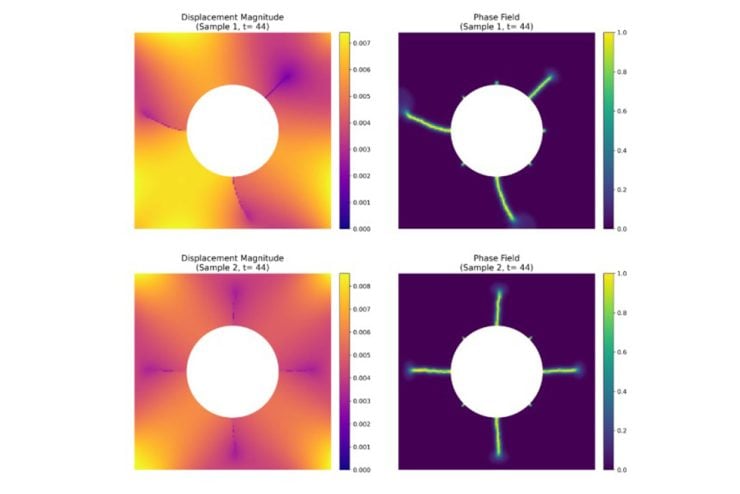
A team of Johns Hopkins researchers that includes engineers Somdatta Goswami and Lori Graham-Brady, along with postdoctoral researcher Maryam Hakimzadeh, will have their fracture mechanics dataset integrated into the National Science Foundation’s National Artificial Intelligence Research Resource Pilot program, known as NAIRR.
Chosen through a competitive process led by NSF in partnership with 12 federal agencies, the dataset is among 10 selected to support the generation, collection, and curation of high-quality data to train the nation’s AI-literate workforce.
The NAIRR Pilot connects U.S. researchers and educators with computational, data, and training resources that advance AI and AI-enabled research. The team’s dataset will support the development of machine learning models to accelerate studies in fracture mechanics.
“Fracture mechanics examines how cracks initiate and grow in materials under stress to predict and ultimately prevent failures, but traditional experiments can take up to five or six hours just to produce one data point for an academic 3D simulation, with many studies requiring months to complete,” says Goswami, assistant professor of civil and systems engineering and Johns Hopkins Data Science and AI Institute affiliate.
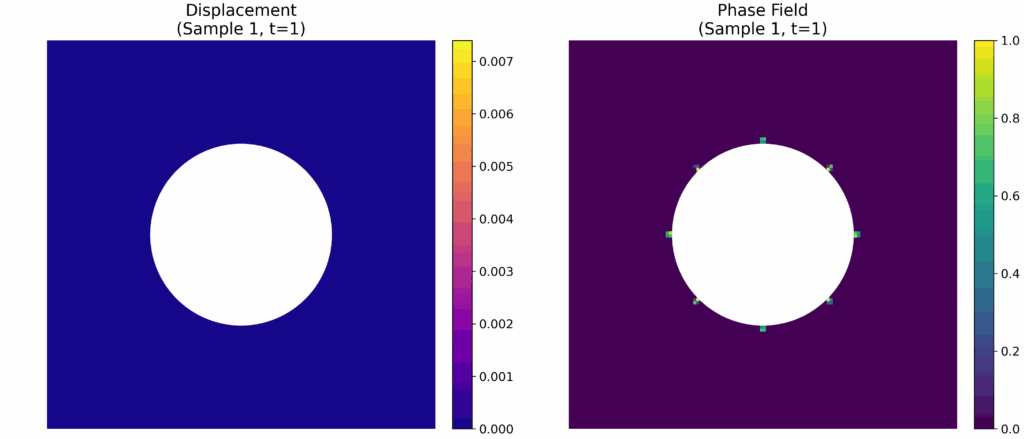
Goswami says that as an engineer, her focus is on building reliable systems and that insights into failure mechanics can help avoid future structural failure. The team’s dataset provides a benchmark to evaluate the performance of new machine learning models that can help accelerate fracture mechanics studies.
“Our dataset applies to hyperelastic materials, or materials that can handle significant stress and deformation before returning to their original form, like a person’s skin or the rubber in your car tires,” says Goswami. “In terms of applications, hyperelastic materials have the potential to improve automotive components, medical devices, and even soft tissue repair.”
The dataset was chosen for its focus on materials with multiple cracks, rather than a larger, single crack, offering broader insight into the complex behavior of materials as they break down. The dataset will help users determine whether their machine learning models are robust enough for fracture mechanics applications. By making their data accessible, the team aims to support resource sharing and increase the speed of discovery within fracture mechanics.
Among the other databases chosen by NAIRR is the Turbulence Database led by Charles Meneveau in Johns Hopkins University’s Department of Mechanical Engineering, along with datasets from institutions including the Monterey Bay Aquarium Research Institute and Purdue University.
