
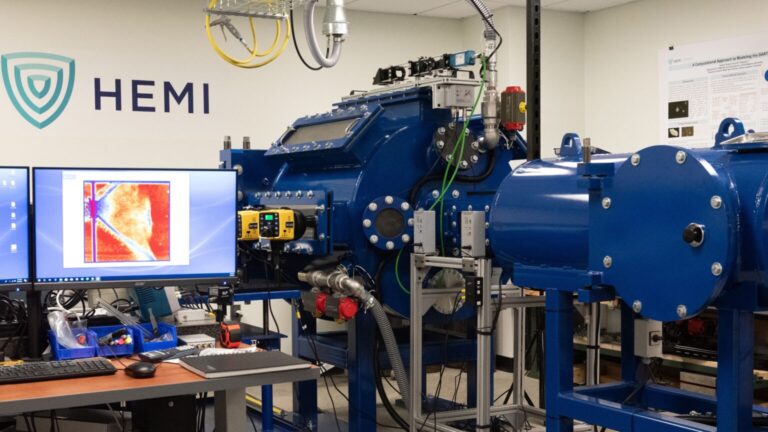
The HEMI Hypervelocity Facility for Impact Research Experiments (HyFIRE) contains a 2 stage light gas gun that is capable of launching impactors at velocities up to 7 km/s.
The facility is located in Malone Hall on the Johns Hopkins University Homewood campus.
Applications
- Hypersonics
- Missile defense
- Space systems
- Planetary science
- Terminal ballistics
- Energetics
Capabilities
- Impact velocities of 1 – 7 km/s
- High-speed optical visualization in stereo (10 Mfps)
- Digital Image Correlation, Digital Gradient Sensing, Photon Doppler Velocimetry
- Orthogonal flash X-ray imaging
- High-speed spectroscopy
Diagnostics
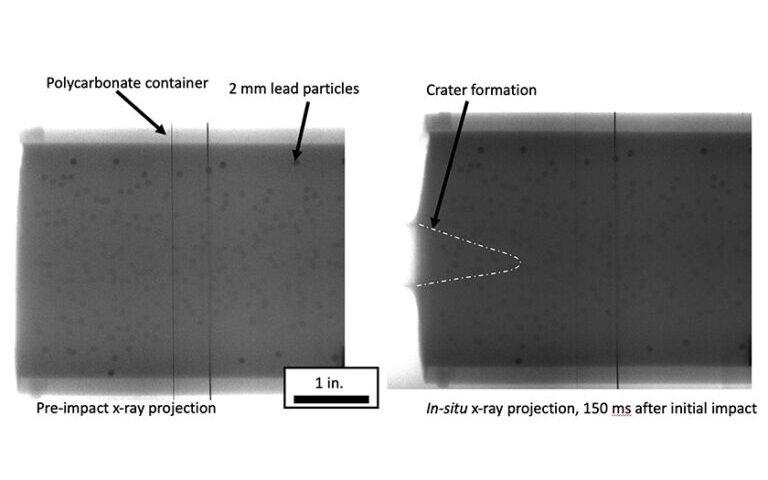
Flash X-Ray
- System: 300 kV L3 Flash X-Ray System
- Channels: 3 single or dual output pulsers
- Peak Voltage on Anodes: 300 kV Single or 150 kV Dual
- X-Ray Pulse Durations: 25-30 ns
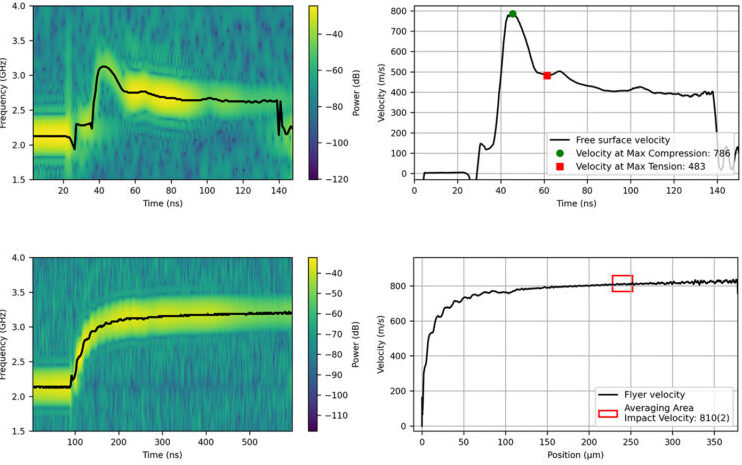
Photon Doppler Velocimetry
- System: 300 kV L3 Flash X-Ray System
- Channels: 3 single or dual output pulsers
- Peak Voltage on Anodes: 300 kV Single or 150 kV Dual
- X-Ray Pulse Durations: 25-30 ns
Back surface velocity measurement
Learn more about the laser shock facility here.
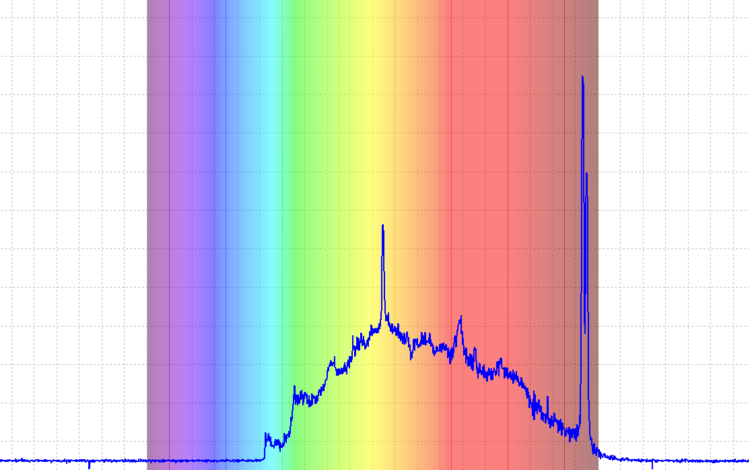
Spectroscopy
Spectroscopy and impact flash diagnostics
- Spectrograph system: Princeton Instruments Iso-Plane 320
- Camera system: Princeton Instruments PIMAX 4-1024i with Dual Image Feature
- Gratings: 500 nm blaze at 150 g/mm, 300 g/mm and 600 g/mm
- Grating Width Minimum: 5 ns
- DIF Minimum Interframe Time: 500 ns
- Spectral Resolution: 0.05 nm
- Spectral Range of IsoPlane 320: 0-1400 nm
High Speed Imaging
Impact visualization, digital gradient sensing (DGS), and 3D digital image correlation (DIC)
HyFIRE works with the following camera and lighting inventories:
- Several Photogenic and Honey Badger flash bulbs for broadband illumination
- 2 Shimadzu HPVX2 cameras, capable of synchronous imaging up to 10 Mfps at 100 ns exposures
- 2 Photron SA5 cameras, with variable resolution and frame rates up to 1 Mfps
- 2 Cavitar / Silux pulsed lasers for synchronous image illumination with the Shimadzus
Video: Yunho Kim, JHU
Launcher Details & Specifications
Primary Breech Gas / Max Pressure: Helium or Nitrogen / 10,000 psi (690 Bar)
Common Sabots: 2 or 4 piece sabots made from high strength nylon or PEEK
Additional Features & Diagnostics
Contact
For additional information regarding HyFIRE, contact:
