The MSEE URA strives to bring together researchers with a wide range of strengths, experience levels, and goals. Over the past five years, we’ve supported more than 400 students, researchers, and staff across 17 institutions. Many of our collaborators have moved on to other institutions within our consortium, and many more have pursued opportunities in industry, academia, federal laboratories, and the military.
Here are testimonials from a few MSEE collaborators who have recently transitioned to new positions.
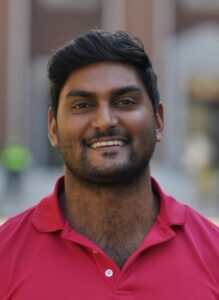 Postdoctoral Fellow,
DEVCOM Chemical Biological Center
MSEE TASK: Research Area 2—Focus Area 2: Tailoring Chemistry Via Materials
“From 2018 to 2025, I was at Johns Hopkins University doing my PhD under Dr. Tim Weihs. MSEE has not only funded the work done during my PhD, but it has connected me with a vast array of knowledgeable individuals across a well developed consortium, and allowed me to develop the skills necessary to begin my career at DEVCOM Chemical Biological Center. The objective of my PhD was to develop a unique combination of diagnostic systems to test reactive material efficacy and improve performance on neutralizing chemical warfare agent simulants. During this time, we reported the first measurements on simulant agent decomposition using reactive materials at sub-second timescales, demonstrated that decomposition variance depends not only on temperature but also chemistry, motivating the exploration of non-thermal mechanisms on rapid defeat. Without MSEE, I would not have been able to collaborate and learn from experts across multiple fields, whose insights ultimately helped construct the multi-spectroscopic system consisting of PRiMIRS and TDLAS. This also led to my current position as a Research Scientist with Leidos at DEVCOM CBC. Here, I hope to expand the scope of these rapid decomposition studies not only on simulants, but also to live chemical agents.”
 Engineer
Naval Surface Warfare Center, Indian Head (NSWC-IH)
MSEE TASK: Research Area 2—Focus Area 2: Tailoring Chemistry Via Materials
“My participation in the Materials Science in Extreme Environments University Research Alliance (MSEE) consortium as a Ph.D. student in Professor Tim Weihs’ group at Johns Hopkins University significantly shaped my career trajectory. MSEE provided invaluable experience in presenting research and navigating technical discussions across diverse expertise levels. Critically, it also allowed me to receive mentoring from experienced scientists and engineers and mentor other students within the program. I honed collaborative and leadership skills through MSEE, skills I now rely on daily to effectively contribute to my team. One particularly impactful moment was participating in my first collaborative project with a Department of War laboratory, where I witnessed firsthand the scale at which my materials were being tested and was thrust into the role of coordinating and managing the testing. Seeing the real-world application, and the dedication of the team involved, ignited my desire to work in a defense lab — a goal that MSEE directly helped me realize. The formal and informal mentorship I experienced, coupled with the unique opportunity to learn from the diverse experiences of others within the program, proved invaluable in preparing me for my current role at the Naval Surface Warfare Center Indian Head Division.”
 Postdoctoral Researcher,
Analytical Earth Science (EES-15)
Los Alamos National Laboratory
MSEE TASK: Research Area 1—Focus Area 2: Materials Constitutive Models
“My work with MSEE centered on understanding how geomaterials behave under high pressure conditions, knowledge that is critical for defense and energy applications in the subsurface environments. I was particularly interested in unraveling the interaction of multiphase fluids such as air and water with the solid phase geomaterials such as sands under high pressure conditions. Much of the previous effort in this research area was focused on dry geomaterials, designing experiments to probe these complex interactions posed significant challenges. Through MSEE, I had the opportunity to approach this problem fundamentally. We custom-designed experimental setup for these conditions and conducted neutron imaging experiments at the Institut Laue-Langevin in France, one of the world’s premier neutron imaging facilities. These experiences were both intellectually rewarding and professionally transformative, enabling me to build strong external collaborations. Recently, I secured beamtime as a Principal Investigator at the Advanced Photon Source, an achievement I attribute to the foundational work I conducted with Prof. Ryan Hurley at Johns Hopkins University through MSEE, DOE, and NSF-supported projects.”
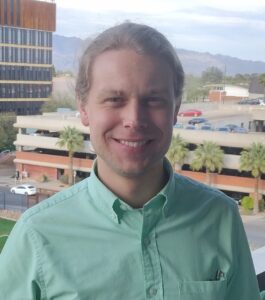 Optical Physicist
Air Force Research Laboratory
MSEE TASK: Research Area 3—Focus Area 1: Nuclear Fireball Plasma Chemistry
“MSEE played a central role in my development as a physicist through supporting much of the research I worked on during graduate school. As a PhD student at the University of Arizona working with Jason Jones, I collaborated with MSEE PIs Mark Phillips and Sivanandan Harilal. Our work utilized frequency combs to perform broadband, high-resolution, time-resolved spectroscopy of laser-produced plasmas used as fireball surrogates. Several publications resulted from this work demonstrating the technique’s ability to measure temperature and number densities of atoms and molecules within the plasma and to determine unknown oscillator strengths of optical transitions.
During this time, I was supported by the SMART Scholarship. After graduating in 2023, I began my service commitment as an optical physicist at AFRL in Albuquerque, NM. I worked for two years in the High Energy Laser division and have recently transitioned to the Quantum Sensing and Timing group. My research experience gained through working on MSEE projects has been critical to my research and continued growth at AFRL. Specifically, I am now applying the expertise I developed on MSEE work in frequency combs and spectroscopy to solving national security problems related to precision navigation and timing.”