
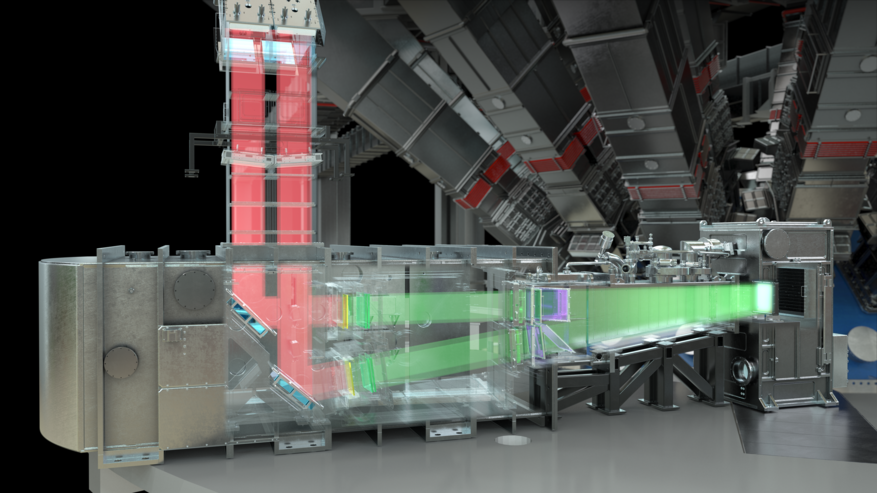
MSEE researchers performed a first-of-its-kind research campaign at LLNL, harnessing high-energy lasers to further our understanding of the processes behind nuclear fusion and fission, a crucial step in both WMD risk reduction and safer, more efficient nuclear energy.
The National Ignition Facility (NIF) at Lawrence Livermore National Laboratory (LLNL) boasts the world’s most powerful laser system; most recently recognized for its landmark achievement of fusion ignition, a long sought-after milestone on the road to fusion energy. The NIF is a massive, one-of-a-kind facility that is the size of two football fields. It contains a staggering 192 beams, two of which can be diverted for Direct Laser Impulse (DLI), a capability that enables the study of direct, high-energy laser ablation with a uniquely large spot size of 36 cm by 36 cm. This large spot size allows very large objects or multiple, relatively large samples to be shot at the same time.
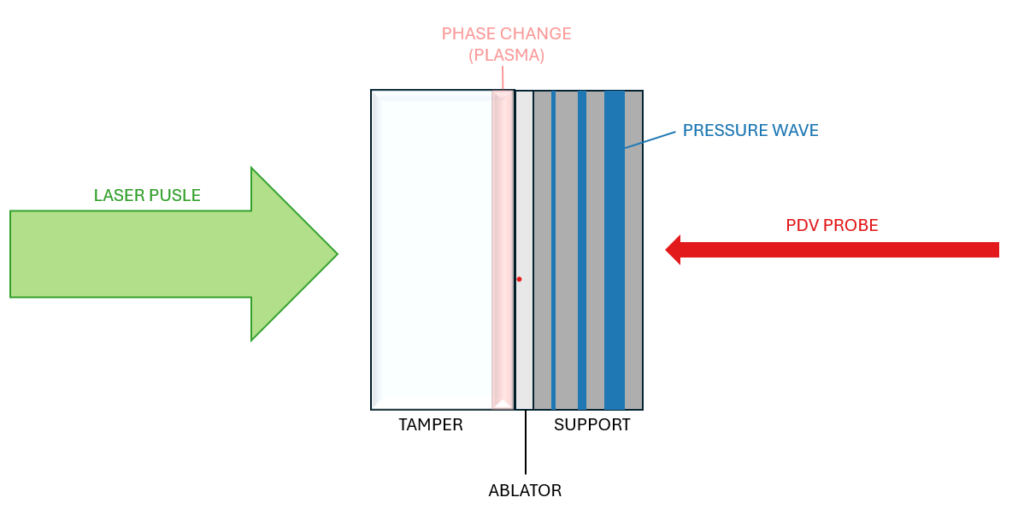
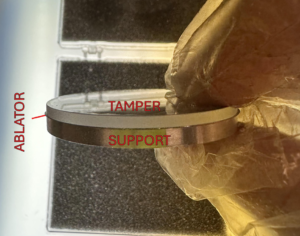 In May 2025, a team of RA4 researchers from the University of California, San Diego and LLNL, conducted a campaign at DLI to investigate the role of tamper materials on laser energy-material coupling. Tamper materials are optically transparent media placed on the incident side of a target with the purpose of simulating nuclear fusion or fission events. Tamped surfaces can produce higher pressures at the target surface and higher rear-surface velocities than their untamped counterparts, resulting in better simulations of extreme environments. This is achieved through confinement of ablation plasma, in which energy which would otherwise be dissipated is transferred to the ablator surface. This principle has been explored at other facilities, including Jupiter Laser Facility (JLF) and Laser Induced compression of Grain scale with High Throughput lab (LIGHT) at LLNL. DLI offers a 12 kJ, 10 ns, square pulse, creating intensities and fluences — laser energy per unit area — where tamper materials are particularly effective.
Eight targets were designed to vary in tamper material, ablator material, and support geometry. DLI’s photonic doppler velocimetry (PDV) diagnostic was used to measure rear surface velocity in situ. The time-resolved data showed that sapphire tampers with aluminum ablators produced peak velocities exceeding 450 m/s, compared to roughly 25 m/s for untamped aluminum ablators. Currently, researchers from MSEE’s RA4 are characterizing the post-shot samples to investigate the resulting deformation and microstructural modifications. These studies reveal substantially more plastic deformation and retained laser modified mass — that is, material remaining on the sample’s surface that has undergone change due to the laser rather than being lost to space — in samples with tampers than those without.
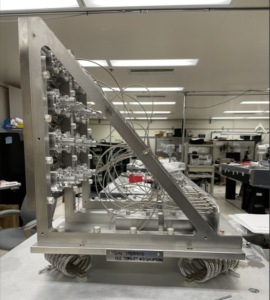
In addition to post-shot sample characterization, the team will return to DLI in 2026 to continue this research with a campaign specifically designed to study two- and three-dimensional geometries with tamper layers. This campaign and future efforts support MSEE’s mission to understand materials behavior under extreme energy conditions by highlighting the importance of material selection and geometric configuration in direct laser ablation.
This work was performed under the auspices of the U.S. Department of Energy by Lawrence Livermore National Laboratory under Contract DE-AC52-07NA27344. This work is sponsored by the Department of Defense, Defense Threat Reduction Agency under the Materials Science in Extreme Environments University Research Alliance, No. HDTRA1-20-2-0001.