

Researchers in the Cross Cutting Research Initiative (CCRI) have developed a cutting-edge diagnostic technique, SHEAR-IFS, that uses high-speed cameras and integral field spectroscopy to investigate the impossibly complex interactions that occur in nuclear blast and agent defeat scenarios.
The high-energy systems being studied in MSEE’s RA2 and RA3 provide rich dynamics that yield critical information on the underlying physical processes involved in agent defeat and nuclear blast scenarios. Spectral emissions—measurable wavelengths of light produced by these energetic reactions—can offer insights into the underlying temperature and chemical composition of materials present during these experiments, but capturing and analyzing this data presents significant challenges. Imaging techniques used to study these high-energy interactions must be able to account for the spatial complexity and short timescales involved. A new diagnostic technique was required to meet these needs, all while recording spectral information locally, globally, and at high speeds.
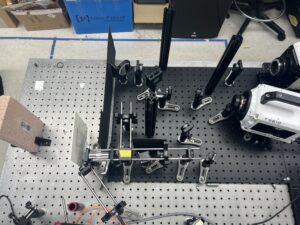 To achieve this, the Foster group at Johns Hopkins University created a variant of SHEAR (Snapshot Hyperspectral Imager for Emissions and Reactions) that utilizes integral field spectroscopy (IFS), a technique borrowed from astronomy. SHEAR-IFS spatially segments spectra which are then recorded by high-speed cameras to provide the spatial and temporal resolution needed to collect data from extreme experimental environments. The design of SHEAR-IFS is relatively simple and can be easily tailored to fit various experiments, making it a robust tool suitable for a wide range of experimental designs and conditions.
SHEAR-IFS has been used by researchers in RA2-FA2 to simultaneously probe both solid and gas phase temperatures of thermite reactions. Michael Zachariah’s group at the University of California Riverside uses SHEAR-IFS, outfitted with two channels, to capture direct measurements of the emissions spectra of both solid and gas phases.
One channel of this SHEAR-IFS setup uses 3-color pyrometry, a technique where each color subpixel of a camera is used to estimate temperature. This non-invasive method measures the temperature of solid-state materials during reactions, but it isn’t applicable to gas-phase temperature measurements. The second channel gathers direct measurements of gases, allowing researchers to isolate spectral emission peaks and use them for temperature fitting. By combining these two channels, researchers can capture a holistic view of temperature throughout the entire experiment, regardless of material phase.
SHEAR-IFS has also been used by researchers at the U.S. Army Combat Capabilities Development Command Army Research Laboratory (DEVCOM ARL) to examine hemispherical C4 explosions. In 2025, DEVCOM ARL researchers used two SHEAR-IFS systems to monitor specific properties during their experiments. The first of these SHEAR-IFS systems was designed to prioritize high spectral resolution and measure specific spectral emissions that occurred during the explosion. Because these emissions are uniquely associated with elements, it becomes possible to identify individual chemical agents in the scene by matching the measured spectra to known spectra.
The second SHEAR-IFS imaging system used at DEVCOM ARL focused on wider spectral range and high spatial resolution, which made it possible to extract temperature over the entire wavefront of the explosion by locally sampling blackbody emissions over the field of view. The combination of these systems allows for a holistic view of both elemental and temperature evolutions during the experiment that can be used for further analysis.[/vc_column_text]